Chapter 6: Process-Centric Description: Concurrent Systems with CSP
This chapter uses two kinds of code examples.
- Tool-compliant blocks: examples intended to be syntactically valid
CSPM for FDR, using ASCII notation such as
->,[],|||,[| X |], andP[[a <- b]] - Pseudo-notation blocks: simplified explanatory notation. Unicode symbols such as
→,□, and⊓, along with some guards,whereclauses, and event parameter conventions, do not necessarily match CSPM exactly and should not be pasted into a tool unchanged
6.1 The Essence of Concurrency: Why It Is Hard
The Limits of Sequential Thinking
The human brain is basically adapted to sequential reasoning. We are good at thinking about one thing after another and advancing a line of logic step by step. That pattern works very well for single-process programs. A flow such as “do A, then B, and based on the result do C or D” is easy to understand.
Concurrent systems are different. Multiple events progress at the same time. In a restaurant, several chefs may be cooking different dishes in parallel while several waiters are serving different tables. Understanding that web of interaction through purely sequential reasoning is difficult.
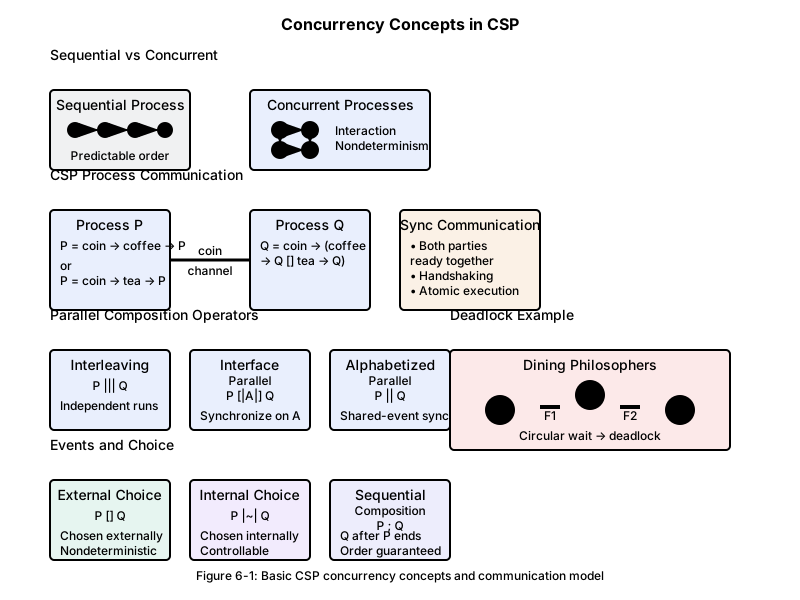
The core difficulty of concurrency is combinatorial explosion in the possible execution patterns. If two processes each perform three operations, there may already be twenty possible interleavings. As the number of processes and the number of operations per process grow, that number increases rapidly.
Emergent Complexity Caused by Interaction
One of the most interesting and difficult features of concurrent systems is that each individual process may be simple while the interaction among them creates unexpected complexity. This is similar to many-body problems in physics or collective behavior in biology.
Consider two processes trying to access the same resource. Each process may be perfectly correct in isolation, yet simultaneous execution can lead to a race condition and produce an unexpected result.
【擬似記法】
Process A: read the resource → update the value → write the resource
Process B: read the resource → update the value → write the resource
If these actions interleave in the wrong way, one update may overwrite the other, causing inconsistent data.
Nondeterminism as Reality
In concurrent systems, nondeterminism is unavoidable. The same initial state may lead to different results depending on scheduling and timing. This makes behavior harder to predict and debugging harder to perform.
Nondeterminism is not purely negative. It can also support flexibility and performance. The real design challenge is to control it while still ensuring safety and liveness.
The Growing Complexity of Time and Causality
In a sequential system, temporal order and causality are relatively clear. If A happens before B, then A can be a cause of B. In a concurrent system, physical time and logical time become less aligned, and causal relations become harder to reason about.
The problem becomes even more serious in distributed systems. Clock synchronization across nodes is difficult, and even the notion of “simultaneous” becomes slippery. In much the same way that relativity complicated the notion of absolute time in physics, distributed systems force us to reason without a single universal clock.
Partial Failure
In concurrent and distributed systems, one part of the system may fail while the rest continues to operate. This is called partial failure, and it introduces another layer of design complexity.
In a conventional sequential system, failure is often global: the whole program crashes. In a distributed system, by contrast, part of the network may be cut off while the remaining nodes continue to run. Maintaining consistency in such a situation is a major design challenge.
The Benefits of Concurrency
Despite these difficulties, concurrency is indispensable in modern systems. There are clear reasons for that.
- Higher performance: multiple CPU cores can be used effectively.
- Better responsiveness: background work can proceed without blocking the user interface.
- Scalability: capacity can be expanded horizontally.
- Availability: the system can tolerate some local failures.
- Natural modeling: many real-world activities are inherently concurrent.
Designing concurrent systems is difficult, but with the right abstraction and formal methods, their complexity can be managed. CSP is one of the strongest tools for doing so.
6.2 The CSP Worldview: Processes and Communication
Tony Hoare’s Insight
CSP, or Communicating Sequential Processes, was introduced by Tony Hoare in
- Hoare’s central insight was that the essence of concurrency lies in communication. The overall behavior of the system depends on how processes exchange messages and synchronize.
This was a major shift in perspective. Earlier approaches to concurrency often focused on shared memory and shared variables. Hoare argued that explicit message passing provides a better abstraction for understanding and designing concurrent systems.
The Abstraction of a Process
In CSP, a process is a sequentially executed pattern of behavior. The important point is that the inside of a process can still be understood in the familiar way: step by step. The complexity is concentrated in the interactions among processes.
That separation allows us to reason independently about the correctness of a single process and the correctness of process interaction. This is a crucial principle for managing complexity.
【擬似記法】
VENDING_MACHINE = coin → (tea → VENDING_MACHINE | coffee → VENDING_MACHINE)
This expression says that a vending-machine process accepts a coin, then allows the choice of tea or coffee, and finally returns to its original state.
Interaction Through Events
In CSP, interaction among processes is abstracted as events. An event may represent message exchange, synchronization, access to a resource, or some other interaction. CSP treats them in one uniform way.
The crucial property of an event is synchrony. An event occurs only when all processes involved in that event are ready. That makes coordination explicit.
【擬似記法】
CUSTOMER = arrive → order → pay → leave → CUSTOMER
CASHIER = greet → order → pay → CASHIER

SYSTEM = CUSTOMER [| {order, pay} |] CASHIER
Because order and pay appear in both processes and are included in the
synchronization set, they occur as rendezvous events. Events with different
names do not synchronize automatically. If synchronization is required, names
must be aligned explicitly or adjusted through renaming.
Structuring Communication with Channels
Real systems often contain many interacting processes. CSP uses channels to structure that interaction. A channel is an abstract route over which messages move between processes.
【ツール準拠(そのまま動く)】
channel in, out : {0..1}

PRODUCER = in!0 -> PRODUCER
BUFFER = in?x -> out!x -> BUFFER
CONSUMER = out?x -> CONSUMER

SYSTEM = (PRODUCER [| {|in|} |] BUFFER) [| {|out|} |] CONSUMER
In this example, PRODUCER synchronizes with BUFFER on in, and BUFFER
synchronizes with CONSUMER on out. The communication structure is visible
in the process composition itself.
Building Systems Hierarchically
One of the strengths of CSP is compositionality. Small processes can be combined to form larger systems. This hierarchical construction allows large systems to be decomposed into understandable pieces.
【擬似記法】
CELL = left?x → right!x → CELL
PIPE(n) = if n = 0 then CELL
          else CELL [| {right, left} |] PIPE(n-1)
This recursive definition constructs a pipeline of arbitrary length.
Integrating Choice and Concurrency
CSP treats choice and concurrency within one unified framework.
External choice (□): the environment determines which branch is taken.
【擬似記法】
ATM = card_insert → (pin_correct → transaction □ pin_incorrect → reject)
Internal choice (⊓): the process chooses nondeterministically.
【擬似記法】
RANDOM = heads → SUCCESS ⊓ tails → FAILURE
Parallel composition: multiple processes run concurrently.
【ツール準拠(そのまま動く)】
PROCESS1 = a -> PROCESS1
PROCESS2 = b -> PROCESS2
PROCESS3 = c -> PROCESS3

SYSTEM = PROCESS1 || PROCESS2 || PROCESS3
The Benefit of Time Abstraction
CSP abstracts away from concrete execution time and focuses on the ordering of events. This abstraction makes it possible to analyze essential system behavior without being distracted by low-level timing details.
When necessary, timing constraints can still be introduced. Timed variants of CSP make durations and deadlines explicit. But the untimed form is valuable precisely because it isolates the logical structure of concurrency first.
Handling Failure and Exceptions
CSP can express not only normal behavior but also faults and exceptional cases. A fault can be treated as just another kind of event, which means failure handling can be integrated into the same control structure as normal behavior.
【擬似記法】
RELIABLE_SERVICE =
  request → (
    success → response → RELIABLE_SERVICE
    □
    failure → retry → RELIABLE_SERVICE
    □
    timeout → abort → RELIABLE_SERVICE
  )
This unified treatment makes it easier to reason about robustness at the design stage.
6.3 Basic Processes and Their Composition
Primitive Processes
All the richer systems described in CSP are built from a small number of basic processes. Understanding these primitives is the foundation of the notation.
STOP: a process that does nothing and cannot proceed, representing a
deadlock state.
【ツール準拠(そのまま動く)】
STOP
SKIP: a process that terminates successfully.
【ツール準拠(そのまま動く)】
SKIP
Simple event processes:
【擬似記法】
a → STOP

a → b → STOP
These primitives are like notes in music: by combining a small vocabulary, we obtain rich behavior.
The Prefix Operator (→)
The prefix operator is the most basic constructor in CSP. It means that after a certain event occurs, the process behaves in a specified way.
【擬似記法】
coin → (tea → STOP | coffee → STOP)
This means that after a coin is inserted, tea or coffee can be selected.
A crucial feature of prefix is that the process waits until the specified event can occur. That waiting behavior is where synchronization becomes visible.
Choice Operators
CSP has several forms of choice, and it is important to understand their semantics.
External choice (□): the environment chooses.
【擬似記法】
ATM = card_insert → pin_entry □ admin_key → maintenance_mode
Here, the environment determines whether a customer inserts a card or an administrator enters maintenance mode.
Internal choice (⊓): the process chooses nondeterministically.
【擬似記法】
COIN_FLIP = heads → WIN ⊓ tails → LOSE
Guarded choice:
【擬似記法】
BUFFER = size < MAX & input?x → add.x → BUFFER
        □ size > 0 & output!first → remove → BUFFER
A guarded branch is available only when its condition holds.
Parallel Composition Operators
The family of operators for parallel composition is central to CSP.
Independent parallel (|||): processes run independently.
【ツール準拠(そのまま動く)】
PRINTER = print_job -> PRINTER
SCANNER = scan_doc -> SCANNER
KEYBOARD = key_press -> KEYBOARD

SYSTEM = PRINTER ||| SCANNER ||| KEYBOARD
These processes do not interact and may proceed independently.
Synchronized parallel ([| X |]): processes synchronize on a chosen set of
events.
【ツール準拠(そのまま動く)】
CUSTOMER = arrive -> order -> pay -> leave -> CUSTOMER
CASHIER = greet -> order -> pay -> CASHIER

SYSTEM = CUSTOMER [| {order, pay} |] CASHIER
The events order and pay must occur jointly, while the others proceed
independently.
Interleaving: the events of processes may be interwoven in any order.
【擬似記法】
AB_SEQUENCE = A ||| B
where A = a → b → A
      B = c → d → B
Pipeline Composition
Pipelines are a standard way to describe staged data flow among processes.
【擬似記法】
PRODUCER = produce.data → c12!data → PRODUCER
PROCESSOR = c12?x → process.x → c23!process(x) → PROCESSOR
CONSUMER = c23?x → consume.x → CONSUMER

PIPELINE = (PRODUCER [| {c12} |] PROCESSOR)
           [| {c23} |] CONSUMER
The producer, processor, and consumer are connected through intermediate channels.
Infinite Processes Through Recursion
Many practical systems must run indefinitely. CSP expresses such behavior naturally through recursion.
Simple recursion:
【擬似記法】
CLOCK = tick → CLOCK
Recursion with state:
【擬似記法】
COUNTER(n) = up → COUNTER(n+1)
           □ down → COUNTER(n-1)
           □ reset → COUNTER(0)
Mutual recursion:
【擬似記法】
PING = ping → PONG
PONG = pong → PING
Process Families
When many similar processes are needed, process families offer a compact way to define them.
【擬似記法】
WORKER(id) = task?t → process.id.t → result!process(t) → WORKER(id)
WORKERS = ||| i:{1..N} @ WORKER(i)
This defines N worker processes running concurrently.
Hiding and Abstraction
To conceal internal events from the external interface, CSP provides the hiding
operator (\).
【ツール準拠(そのまま動く)】
INTERNAL_PROCESS = internal_event1 -> internal_event2 -> external_event -> INTERNAL_PROCESS
PUBLIC_INTERFACE = INTERNAL_PROCESS \ {internal_event1, internal_event2}
This exposes only the public behavior while suppressing internal details.
Renaming
CSP also supports renaming, which is useful for reusing generic processes in a more specific setting.
【ツール準拠(そのまま動く)】
channel in, out : {0..1}
channel input, output : {0..1}

GENERIC_BUFFER = in?x -> out!x -> GENERIC_BUFFER
SPECIFIC_BUFFER = GENERIC_BUFFER[[in <- input, out <- output]]
Design Principles for Process Composition
Useful principles for composing CSP processes include the following.
- Minimal interfaces: synchronize only where necessary.
- Symmetry: use symmetric designs where possible.
- Reuse: write generic process definitions.
- Stepwise refinement: move gradually from abstraction to detail.
These principles help produce concurrent designs that remain understandable and maintainable.
6.4 Synchronization and Communication
The Essential Meaning of Synchronization
Synchronization is one of the core concepts in concurrent systems. In CSP, it means that multiple processes coordinate at a particular event. The analogy is an orchestra following a conductor or dancers moving together to the same beat.
CSP uses a rendezvous-style notion of synchronization. An event can occur only when all processes involved in that event are ready. That requirement expresses coordination directly.
How Channel Communication Works
CSP models communication through channels.
Output (!): send a message.
【擬似記法】
SENDER = ch!message → SENDER
Input (?): receive a message.
【擬似記法】
RECEIVER = ch?x → process.x → RECEIVER
Synchronous communication: send and receive occur together.
【ツール準拠(そのまま動く)】
channel ch : {0..1}

SENDER = ch!0 -> SENDER
RECEIVER = ch?x -> RECEIVER

COMMUNICATION = SENDER [| {|ch|} |] RECEIVER
In this abstraction, send and receive are one synchronized event. If real systems must model loss, delay, retransmission, or buffering, those phenomena need to be represented explicitly.
The Idea of Buffering
Real communication often requires buffering. In CSP, a buffer can itself be modeled as a process.
Single-element buffer:
【擬似記法】
BUFFER1 = in?x → out!x → BUFFER1
Buffer of capacity N:
【擬似記法】
BUFFER(n) = (n > 0) & out!front → BUFFER(n-1)
          □ (n < MAX) & in?x → BUFFER(n+1)
FIFO buffer:
【擬似記法】
FIFO_BUFFER(queue) =
  (queue ≠ ⟨⟩) & out!head(queue) → FIFO_BUFFER(tail(queue))
  □ (len(queue) < MAX) & in?x → FIFO_BUFFER(queue ⌢ ⟨x⟩)
Priority-Based Communication
Some systems need message priorities.
【擬似記法】
PRIORITY_HANDLER =
  urgent?x → handle_urgent.x → PRIORITY_HANDLER
  □ normal?y → handle_normal.y → PRIORITY_HANDLER
  where urgent has priority over normal
Broadcast Communication
Sometimes a single message must be delivered to multiple receivers.
【擬似記法】
BROADCASTER = message?x → (out1!x || out2!x || out3!x) → BROADCASTER

MULTICAST_SYSTEM = BROADCASTER
                 [| {out1} |] RECEIVER1
                 [| {out2} |] RECEIVER2
                 [| {out3} |] RECEIVER3
Selective Communication
A router-like process may choose the communication partner based on the message’s destination.
【擬似記法】
ROUTER =
  input?msg → (
    (destination(msg) = A) & to_A!msg → ROUTER
    □ (destination(msg) = B) & to_B!msg → ROUTER
    □ (destination(msg) = C) & to_C!msg → ROUTER
  )
Communication with Timeouts
Real systems also need to cope with delay and failure.
【擬似記法】
RELIABLE_SENDER =
  send!message → (
    ack → SUCCESS
    □ timeout → retry → RELIABLE_SENDER
  )
Handshake Protocols
More elaborate communication often requires multi-stage handshakes.
【擬似記法】
CLIENT = request!req → response?res → CLIENT
SERVER = request?req → process.req → response!result → SERVER

THREE_WAY_HANDSHAKE =
  syn → syn_ack → ack → ESTABLISHED
Classes of Synchronization Patterns
Synchronization patterns in CSP include the following.
- One-to-one communication: simple point-to-point messaging
- One-to-many communication: broadcast or multicast
- Many-to-one communication: multiple senders to one receiver
- Many-to-many communication: richer network-style interaction
Barrier synchronization:
【擬似記法】
BARRIER(n) =
  (n > 1) & arrive → BARRIER(n-1)
  □ (n = 1) & arrive → release → BARRIER(N)
The Leader-Follower Pattern
Hierarchical control structures can also be modeled directly.
【擬似記法】
LEADER =
  decision!cmd → (
    follower1.ack → follower2.ack → follower3.ack → commit
  ) → LEADER

FOLLOWER(id) =
  decision?cmd → execute.cmd → ack → FOLLOWER(id)
Voting Protocols
Agreement protocols in distributed systems can be captured as CSP processes.
【擬似記法】
VOTER(id) = vote_request?proposal →
           (approve!id → VOTER(id) □ reject!id → VOTER(id))

COORDINATOR =
  broadcast_proposal →
  collect_votes →
  (majority_approve & commit □ majority_reject & abort) →
  COORDINATOR
Communication Reliability
Practical systems often require explicit handling of communication failures.
Message loss:
【擬似記法】
LOSSY_CHANNEL = msg?x → (deliver!x □ lose → SKIP) → LOSSY_CHANNEL
Duplicate elimination:
【擬似記法】
DEDUP_RECEIVER =
  msg?x → (
    (x ∉ received) & process.x → DEDUP_RECEIVER[received ∪ {x}]
    □ (x ∈ received) & duplicate → DEDUP_RECEIVER
  )
Ordering guarantee:
【擬似記法】
ORDERED_DELIVERY =
  in?⟨seq, msg⟩ → (
    (seq = expected) & out!msg → ORDERED_DELIVERY[expected+1]
    □ (seq ≠ expected) & buffer.⟨seq,msg⟩ → ORDERED_DELIVERY
  )
By combining such communication patterns, CSP can describe the behavior of realistic distributed systems in a disciplined way.
6.5 Deadlock and Liveness: The Pathology of Systems
Deadlock as a Pathological Phenomenon
Deadlock is one of the most serious problems in a concurrent system. Multiple processes wait for one another, and the entire system reaches a state in which no useful progress is possible. A familiar analogy is four cars stuck at an intersection, each waiting for another to move first.
In CSP, deadlock can be defined formally. The system is deadlocked when every participating process is waiting for an event that another waiting process would have to initiate.
【擬似記法】
DEADLOCK_EXAMPLE =
  (a → b → STOP) [| {a, b} |] (b → a → STOP)
Here, the left process waits for a while the right process waits for b, so
neither can move.
The Four Conditions for Deadlock
Classical results say that four conditions are jointly necessary for deadlock.
- Mutual exclusion: a resource cannot be used simultaneously by multiple processes.
- Hold and wait: a process holds one resource while waiting for another.
- No preemption: resources cannot be forcibly taken away.
- Circular wait: there is a cycle in the wait-for relation.
CSP can describe these conditions explicitly.
【擬似記法】
RESOURCE = acquire → use → release → RESOURCE

PROCESS = resource1.acquire → resource2.acquire →
          work → resource2.release → resource1.release → PROCESS

SYSTEM = (P1 [| {r1,r2} |] P2) \ {r1,r2}
where P1 = r1.acquire → r2.acquire → work → r2.release → r1.release → P1
      P2 = r2.acquire → r1.acquire → work → r1.release → r2.release → P2
Deadlock Avoidance Strategies
To avoid deadlock, at least one of the four conditions must be broken.
Resource ordering:
【擬似記法】
ORDERED_PROCESS =
  (id(r1) < id(r2)) & r1.acquire → r2.acquire → work →
  r2.release → r1.release → ORDERED_PROCESS
If all processes acquire resources in the same global order, circular wait can be prevented.
Timeout mechanism:
【擬似記法】
TIMEOUT_PROCESS =
  r1.acquire → (
    r2.acquire → work → r2.release → r1.release → TIMEOUT_PROCESS
    □ timeout → r1.release → retry → TIMEOUT_PROCESS
  )
Banker’s algorithm:
【擬似記法】
BANKER =
  request?⟨pid, resource⟩ → (
    safe_state(allocate(pid, resource)) & grant!pid → BANKER
    □ ¬safe_state(allocate(pid, resource)) & deny!pid → BANKER
  )
Livelock as a More Subtle Problem
Livelock is different from deadlock. The system is active, but not making real progress. A common analogy is two people in a narrow corridor repeatedly trying to step aside in the same direction.
【擬似記法】
LIVELOCK_EXAMPLE =
  P1 [| {move} |] P2
where P1 = move.left → detect_collision → move.right → P1
      P2 = move.right → detect_collision → move.left → P2
Guaranteeing Liveness
Liveness means that “something good eventually happens.” In CSP, liveness can be analyzed from several perspectives.
Starvation freedom: every process eventually makes progress.
【擬似記法】
FAIR_SCHEDULER =
  schedule!p1 → schedule!p2 → schedule!p3 → FAIR_SCHEDULER
Fairness: a process that continually has the opportunity to proceed is ultimately allowed to do so.
【擬似記法】
FAIR_ACCESS =
  (request.p1 → grant.p1 → FAIR_ACCESS) |||
  (request.p2 → grant.p2 → FAIR_ACCESS) |||
  FAIRNESS_CONSTRAINT
Formalizing Progress Conditions
Progress guarantees can also be written abstractly.
Minimal progress guarantee:
【擬似記法】
PROGRESS = □◊(progress_event)
This reads as: always, eventually, a progress event occurs.
Bounded waiting:
【擬似記法】
BOUNDED_WAIT = request → ◊≤n(grant)
This expresses that after a request, permission is granted within at most n
time units.
Detection and Recovery
Detection and recovery mechanisms are also important parts of a practical system.
Deadlock detector:
【擬似記法】
DETECTOR =
  monitor_state → (
    deadlock_detected & recovery_action → DETECTOR
    □ normal_state & continue → DETECTOR
  )
Recovery strategies:
【擬似記法】
RECOVERY =
  abort_victim → rollback → restart → RECOVERY
  □ preempt_resource → reassign → RECOVERY
The Dining Philosophers Problem
A classic illustration of deadlock is the dining philosophers problem.
【擬似記法】
PHILOSOPHER(i) =
  pickup.left(i) → pickup.right(i) → eat →
  putdown.right(i) → putdown.left(i) → think → PHILOSOPHER(i)

DINING_PHILOSOPHERS =
  ||| i:{1..5} @ PHILOSOPHER(i)

PHILOSOPHER_FIXED(i) =
  (i < 5) & pickup.left(i) → pickup.right(i) → eat →
           putdown.right(i) → putdown.left(i) → think → PHILOSOPHER_FIXED(i)
  □ (i = 5) & pickup.right(i) → pickup.left(i) → eat →
              putdown.left(i) → putdown.right(i) → think → PHILOSOPHER_FIXED(i)

WAITER =
  request.i → (
    available_forks(i) & grant.i → WAITER
    □ ¬available_forks(i) & wait.i → WAITER
  )
The example illustrates both a problematic design and two standard remedies: asymmetric acquisition order and waiter-based control.
Impact on Performance
Deadlock-avoidance measures often have performance costs.
- Conservative strategies are safe but may reduce efficiency.
- Optimistic strategies are efficient but may incur higher recovery cost.
- Adaptive strategies switch behavior depending on load or contention.
【擬似記法】
ADAPTIVE_SYSTEM =
  low_contention & OPTIMISTIC_PROTOCOL
  □ high_contention & CONSERVATIVE_PROTOCOL
Tool-Based Verification
Dedicated tools can analyze CSP models for deadlock and related properties.
- FDR (Failures-Divergences Refinement): rigorous model checking and refinement analysis
- ProB: model checking and animation support
- PAT: support for richer verification scenarios, including probabilistic reasoning
These tools allow deadlock risks to be discovered and corrected while the system is still at the design stage.
6.6 Learning Through an Example: Designing a Restaurant System
Organizing the System Requirements
A restaurant system is a strong example for concurrent design. Multiple roles — customers, waiters, chefs, and cashiers — must coordinate while sharing limited resources such as tables, kitchen equipment, and ingredients.
Main actors:
- customers;
- waiters;
- chefs;
- cashier; and
- manager.
Shared resources:
- tables;
- kitchen equipment;
- ingredient inventory; and
- menu information.
Main processes:
- customer arrival and seating;
- order intake and transmission to the kitchen;
- cooking and serving; and
- billing and departure.
Defining Basic Processes
We can begin by describing the basic behavior of each role.
【擬似記法】
CUSTOMER(id) =
  arrive → wait_for_table →
  seat.id → browse_menu → order.id →
  wait_for_food → eat → request_bill →
  pay → leave → CUSTOMER(id)

WAITER(id) =
  greet_customer → take_order →
  transmit_to_kitchen → serve_food →
  present_bill → process_payment →
  clean_table → WAITER(id)

CHEF(id) =
  receive_order → check_ingredients →
  cook → plate_food → ready_for_service →
  CHEF(id)

CASHIER =
  receive_payment_request → calculate_total →
  process_payment → issue_receipt → CASHIER
The Table-Management Subsystem
Table assignment is a core subsystem. A limited number of seats must be managed efficiently while avoiding coordination problems.
【擬似記法】
TABLE_MANAGER =
  customer_arrives → (
    available_table & assign_table → TABLE_MANAGER
    □ no_available_table & add_to_waitlist → TABLE_MANAGER
  )
  □ table_freed → update_availability →
    (waitlist_empty & TABLE_MANAGER
     □ waitlist_not_empty & serve_next_customer → TABLE_MANAGER)

TABLE(id) =
  reserve.id → occupied.id →
  serve.id → eating.id →
  clear.id → clean.id → TABLE(id)

RESTAURANT_TABLES =
  ||| table_id:{1..N} @ TABLE(table_id)
The Order-Processing Workflow
Order processing from intake through serving can be described as a set of cooperating concurrent processes.
【擬似記法】
ORDER_TAKING =
  customer_ready → approach_table →
  present_menu → answer_questions →
  take_order → confirm_order →
  transmit_to_kitchen → ORDER_TAKING

KITCHEN_ORDER_MANAGER =
  new_order?order → (
    ingredients_available(order) &
    assign_to_chef!order → KITCHEN_ORDER_MANAGER
    □ ingredients_unavailable(order) &
    inform_shortage → KITCHEN_ORDER_MANAGER
  )

COOKING_PROCESS(chef_id) =
  assigned_order?order →
  gather_ingredients.order →
  cook.order →
  quality_check.order →
  ready_for_pickup!order →
  COOKING_PROCESS(chef_id)

FOOD_SERVICE =
  food_ready?order →
  locate_customer.order →
  deliver_food.order →
  check_satisfaction →
  FOOD_SERVICE
Resource Management for Kitchen Equipment
Kitchen equipment such as stoves and ovens must be managed with mutual exclusion.
【擬似記法】
EQUIPMENT_MANAGER =
  request_equipment?⟨chef, equipment⟩ → (
    equipment_available(equipment) &
    grant_access!⟨chef, equipment⟩ → EQUIPMENT_MANAGER
    □ equipment_busy(equipment) &
    queue_request!⟨chef, equipment⟩ → EQUIPMENT_MANAGER
  )
  □ release_equipment?⟨chef, equipment⟩ →
    update_availability →
    serve_next_request → EQUIPMENT_MANAGER

STOVE(id) =
  reserve.id → cooking.id → release.id → STOVE(id)

OVEN(id) =
  preheat.id → reserve.id → baking.id → release.id → OVEN(id)

KITCHEN_EQUIPMENT =
  (||| stove_id:{1..4} @ STOVE(stove_id))
  |||
  (||| oven_id:{1..2} @ OVEN(oven_id))
The Inventory-Management System
Ingredient inventory and replenishment also form an important concurrent subsystem.
【擬似記法】
INVENTORY_MANAGER =
  use_ingredient?⟨ingredient, quantity⟩ → (
    sufficient_stock(ingredient, quantity) &
    update_stock → check_reorder_level →
    (below_threshold & trigger_reorder □ adequate_stock & SKIP) →
    INVENTORY_MANAGER
    □ insufficient_stock(ingredient, quantity) &
    report_shortage → INVENTORY_MANAGER
  )
  □ receive_delivery?⟨ingredient, quantity⟩ →
    update_stock → INVENTORY_MANAGER

AUTO_ORDERING =
  check_inventory → (
    reorder_needed & place_order → wait_for_delivery → AUTO_ORDERING
    □ stock_adequate & schedule_next_check → AUTO_ORDERING
  )
The Payment-Processing System
A practical restaurant must also support several payment methods.
【擬似記法】
PAYMENT_PROCESSING =
  payment_request?⟨table, amount⟩ →
  calculate_total.amount →
  present_payment_options →
  (cash_payment → process_cash → issue_receipt → PAYMENT_PROCESSING
   □ card_payment → process_card →
     (transaction_approved & issue_receipt → PAYMENT_PROCESSING
      □ transaction_declined & request_alternative → PAYMENT_PROCESSING)
   □ digital_payment → process_digital →
     verify_payment → issue_receipt → PAYMENT_PROCESSING)

ACCOUNTING_SYSTEM =
  transaction_completed?details →
  record_sale → update_daily_total →
  (end_of_day & generate_report □ continue_operation) →
  ACCOUNTING_SYSTEM
Emergency Handling
Emergency cases such as food-safety incidents or fire must also be represented.
【擬似記法】
EMERGENCY_SYSTEM =
  (fire_alarm → evacuate_all → shutdown_equipment → EMERGENCY_SYSTEM
   □ food_safety_issue → stop_affected_orders → investigate → EMERGENCY_SYSTEM
   □ power_outage → emergency_lighting → preserve_cold_storage → EMERGENCY_SYSTEM
   □ normal_operation → monitor → EMERGENCY_SYSTEM)

EVACUATION_PROTOCOL =
  emergency_detected →
  sound_alarm →
  (guide_customers_out ||| secure_premises ||| contact_authorities) →
  all_clear → resume_operations → EVACUATION_PROTOCOL
Integrating the Whole System
Once the subsystems are defined, they can be composed into one whole system.
【擬似記法】 The following is a conceptual composition example. Because several process definitions are omitted, it should not be treated as executable CSPM as-is.
RESTAURANT_SYSTEM =
  (CUSTOMER_MANAGEMENT
   [| {arrive, seat, order, pay, leave} |]
   STAFF_COORDINATION)
  [| {order, food_ready, payment} |]
  (KITCHEN_OPERATIONS
   [| {ingredients, equipment} |]
   RESOURCE_MANAGEMENT)
  \ {internal_communications}

where
  CUSTOMER_MANAGEMENT = ||| id:{1..MAX_CUSTOMERS} @ CUSTOMER(id)
  STAFF_COORDINATION =
    (||| id:{1..N_WAITERS} @ WAITER(id)) |||
    (||| id:{1..N_CHEFS} @ CHEF(id)) |||
    CASHIER
  KITCHEN_OPERATIONS =
    KITCHEN_ORDER_MANAGER |||
    (||| id:{1..N_CHEFS} @ COOKING_PROCESS(id))
  RESOURCE_MANAGEMENT =
    INVENTORY_MANAGER |||
    EQUIPMENT_MANAGER |||
    TABLE_MANAGER
Considering Performance Optimization
A practical system must also address performance.
【擬似記法】
LOAD_BALANCER =
  new_order?order → (
    find_least_busy_chef →
    assign_order!⟨chef, order⟩ → LOAD_BALANCER
  )

PEAK_TIME_MANAGEMENT =
  detect_rush_hour →
  (increase_staff ||| prioritize_fast_orders ||| optimize_seating) →
  monitor_queue_length →
  (acceptable_wait_time & continue □ excessive_wait & escalate) →
  PEAK_TIME_MANAGEMENT
Properties That Should Be Verified
Important verification targets for the restaurant system include the following.
Safety:
- absence of deadlock;
- correct mutual exclusion on shared resources; and
- adherence to food-safety rules.
Liveness:
- every customer is eventually served;
- orders do not remain delayed forever; and
- equipment is not occupied forever without progress.
Fairness:
- service follows a fair queueing policy;
- staff workload is balanced; and
- resources are shared fairly.
The restaurant example shows how CSP can be applied to a realistic system that combines concurrency, resource management, communication, and error handling in one framework.
End-of-Chapter Exercises
If you use AI while working through these exercises
- Treat AI output as a proposal; use verifiers to make the final judgment.
- Keep a record of the prompts you used, the generated specifications and invariants, the verification commands and logs (including seed, depth, and scope), and the revision history when counterexamples were found.
- For detailed templates, see Appendix D and Appendix F.
Basic Exercise 1: Reading CSP Notation
Read the following CSP process definitions and explain the behavior of the system.
【擬似記法】
PRODUCER = produce → buffer!item → PRODUCER
CONSUMER = buffer?x → consume.x → CONSUMER
BUFFER = in?x → out!x → BUFFER

SYSTEM = PRODUCER [| {buffer} |] BUFFER[buffer/in, buffer/out] [| {buffer} |] CONSUMER
Explain:
- the role and behavior of each process;
- the synchronization points among the processes;
- the data flow through the whole system; and
- an example of a possible execution sequence.
Basic Exercise 2: Deadlock Analysis
Analyze whether the following system can deadlock.
【擬似記法】
PROCESS_A = resource1.acquire → resource2.acquire →
           work → resource2.release → resource1.release → PROCESS_A

PROCESS_B = resource2.acquire → resource1.acquire →
           work → resource1.release → resource2.release → PROCESS_B

SYSTEM = PROCESS_A [| {resource1.acquire, resource1.release,
                     resource2.acquire, resource2.release} |] PROCESS_B
Discuss:
- a deadlock scenario;
- the four deadlock conditions and whether they hold;
- at least two prevention strategies; and
- a corrected CSP definition.
Practical Exercise 1: Designing an ATM System
Model an ATM system in CSP satisfying the following requirements.
Basic functions:
- card insertion and PIN entry;
- balance inquiry, withdrawal, and deposit; and
- receipt printing and card ejection.
Concurrency requirements:
- multiple ATMs access the same banking system;
- each ATM serves at most one customer at a time; and
- access to the central banking system must be controlled safely.
Safety requirements:
- prevent unauthorized access;
- reject withdrawals when funds are insufficient; and
- stop safely under network failure.
Tasks:
- define the main processes;
- define the resource-management mechanism;
- integrate error handling; and
- compose the whole system.
Practical Exercise 2: Using Process Composition
For the ATM system above, extend the design in the following ways.
- Hierarchical design
- build composite operations from basic operations;
- separate the interface layer from the business-logic layer.
- Concurrency control
- support concurrent use by multiple customers at different ATMs;
- add a maintenance mode for administrators.
- Communication patterns
- introduce reliable communication between ATMs and the central system;
- add failure detection and recovery.
Advanced Exercise: Designing a Distributed System
Design a distributed file system in CSP.
System structure:
- multiple client nodes;
- multiple storage nodes; and
- redundant metadata servers.
Requirements:
- file read and write operations;
- data redundancy through replication;
- tolerance to node failures; and
- consistency guarantees.
Design tasks:
- inter-node communication protocol;
- failure detection and recovery;
- distributed agreement algorithm; and
- load-balancing mechanism.
Properties to verify:
- absence of deadlock;
- preservation of data consistency;
- robustness under partial failure; and
- fairness, meaning that every client eventually receives service.
Through these exercises, you should acquire practical skill in designing concurrent systems with CSP and be prepared for the richer treatment of temporal properties in the next chapter.