Introduction: Why Compositional Design Matters
Many AI-assisted teams can explain which tool ran, but they cannot explain why one generated path was allowed to alter production-bound software.
This introduction frames the book around that gap between automation detail and governable design.
Its running example is the policy-gated change review, which follows a Change Request through a Review Plan to an Approved Change.
The body chapters also reuse a smaller deployment-approval cue so that release-governance readers can see the same method before they reach Appendix D.
Use Appendix A for notation and Appendix B for canonical terms.
Learning goals
- Explain why AI-assisted engineering needs explicit artifacts, boundaries, and compositional review claims.
- Identify the audience, reading paths, and reference material that organize the rest of the book.
- Understand how the running example anchors later formal chapters while a smaller deployment-approval cue shows that the method is not repository-exclusive.
Prerequisites
- Familiarity with repositories, pull requests, architecture diagrams, and technical review.
- Willingness to inspect example artifacts alongside the prose when a chapter introduces a new formal term.
Key concepts
compositional designAI agentresponsibility boundaryChange Request
Running example linkage
- The common running example is the canonical repository source behind the full manuscript.
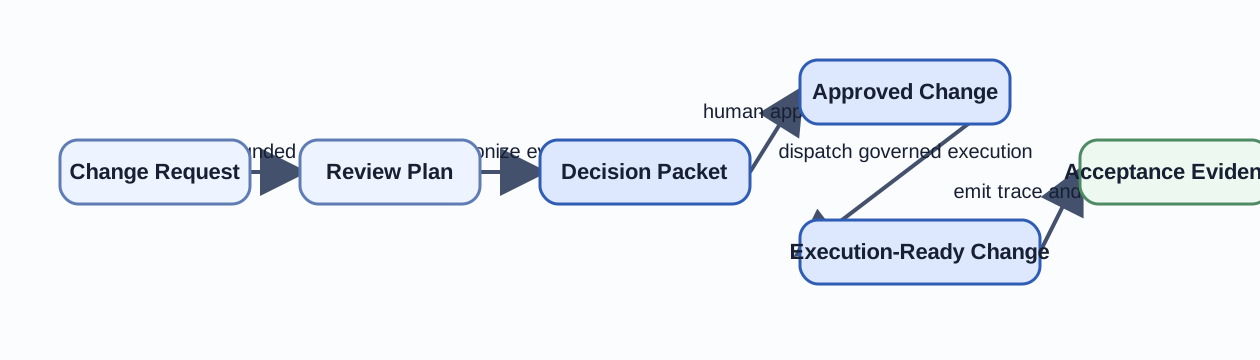
- For a first reading, Figure 0.1 and Table 0.1 carry the local path through request, approval, and evidence, while the minimal example remains the shortest reusable repository form.
- The book keeps repository change review as the canonical example, but it threads deployment approval as a smaller recurring cue so the same compositional method is visible in a second governed workflow before the appendix.
Figure 0.1 gives the reader one compact map of the governed path before the later chapters formalize each boundary.
Figure 0.1. Compositional design keeps authority attached to artifacts instead of to opaque automation.
Reader takeaway. The book’s core promise is that higher-stakes AI-assisted work should cross visible artifact, approval, and evidence boundaries rather than one opaque automation boundary.
Why AI-assisted engineering needs stronger structure
AI assistance increases delivery speed, but it also inserts more hidden transformations between intent and execution. A team that cannot name those transformations cannot review them with confidence.
Hidden complexity in agentic workflows
An AI agent rarely acts alone. It receives prompt context, consults tools, rewrites artifacts, and hands results back into human or automated checkpoints. Each of those steps can preserve the meaning of the original request, or distort it.
In the running example, a repository maintainer submits a Change Request.
An AI agent drafts a Review Plan that scopes the change, names required checks, and points to candidate files.
A human reviewer decides whether the proposed path is acceptable before the change becomes an Approved Change.
If the team treats that path as one opaque automation, responsibility becomes diffused. When the plan is wrong, nobody can say whether the defect started in the request, the prompt context, the policy gate, or the review decision. The result is not only operational risk. It is design ambiguity.
The system now has hidden transformations, hidden assumptions, and hidden effect boundaries. This book argues that those elements should be made explicit as software artifacts and review questions.
Why composition is a governance tool
Composition is often introduced as a mathematical operation. In engineering practice, it is also a governance tool because it lets us ask whether a longer path preserves the meaning promised by its shorter steps.
If draft-review-plan followed by human-approval is supposed to realize policy-gated-approval, the team can inspect each step separately and the claim they make together.
That shift matters because many failures in AI-assisted delivery do not come from isolated components.
They come from poorly governed compositions between prompts, tools, policy checks, and approvals.
A compositional view does not replace architecture reviews, test plans, or audits. It gives them a common language. The language is simple enough to use in issue templates, change reviews, workflow diagrams, and incident retrospectives.
Later chapters will formalize that language with objects, morphisms, diagrams, universal constructions, and effect boundaries. The purpose of this introduction is to show why those ideas are worth learning before the formal vocabulary appears.
Who this book is for
This book is written for readers who need both delivery speed and governance clarity. Its central use case is not abstract theorem proving. It is the design of reviewable software systems in which humans and AI agents share work without sharing accountability blindly.
Primary readers and use cases
The primary readers are software architects, staff engineers, technical leads, platform engineers, and AI product builders. The secondary readers are engineering managers and review owners who must decide where automation can act directly and where human approval must remain mandatory.
Some readers will use the book to design new agentic workflows. Others will use it to repair existing delivery pipelines that have become difficult to audit. The common thread is the need to connect abstract design claims to concrete artifacts.
If your team asks questions such as “Which decisions may an agent make on its own”, “What evidence must exist before a higher-risk action runs”, or “How do we know that a diagram, a workflow, and a pull request still describe the same system”, this book is aimed at that situation. The examples assume familiarity with repositories, interfaces, tests, reviews, deployment controls, and operational feedback loops. They do not assume a research background in category theory.
What prior knowledge is assumed
You should already be comfortable reading technical specifications, interface contracts, pull requests, and architecture diagrams. You should also be comfortable distinguishing design intent from implementation detail. No prior knowledge of proofs is required.
When formal notation appears, it is introduced only to compress a concrete engineering claim that would otherwise take too much prose. The book does assume that you are willing to reason carefully about invariants, boundaries, and preserved meaning. That stance matters more here than mathematical fluency.
A reader who can already review a risky change request will have enough background to follow the argument. A reader who wants a pure mathematics treatment of category theory will find the formal content selective by design. The center of the book is software design for the AI agent era, not category theory for its own sake.
What the reader will gain
The book aims to leave the reader with reusable design moves rather than chapter-local definitions. Those moves should be applicable to repositories, internal platforms, workflow engines, and higher-stakes systems that incorporate AI assistance.
Design vocabulary and review patterns
By the end of the book, you should be able to name stable artifacts as objects, meaningful transformations as morphisms, and preserved outcomes as compositional claims. That vocabulary is useful because it turns vague review discussions into inspectable statements.
A reviewer can ask whether a transformation preserves an invariant. An architect can ask whether two design views are related by a structure-preserving translation. An operations lead can ask whether an effect boundary is explicit enough to contain rollback and incident response.
Those questions are more precise than generic advice such as “be careful with AI output.”
They point to specific artifacts and specific failure modes.
The running example is intentionally small so that the same review pattern appears repeatedly.
When the book returns to the Change Request, the Review Plan, and the Approved Change, the reader can focus on the new concept rather than relearning the domain.
A reusable workflow for AI-assisted delivery
The practical outcome is a workflow for AI-assisted delivery that remains auditable and technically coherent. It starts with a problem statement and acceptance criteria. It continues with an artifact map, a diagram that states the main preservation claim, a verification plan, and an implementation workflow that distinguishes agent authority from human authority.
That packet is small enough to maintain in a repository and rich enough to support review, change control, and later verification. The workflow is not tied to one toolchain or one agent platform. It is a way to structure the boundary between intention, transformation, approval, and execution. The same packet logic can govern release approval as well as repository review when both workflows keep bounded requests, governed decisions, and post-approval evidence explicit.
Teams can scale it up for larger systems or reduce it for smaller changes. What should remain stable is the demand for explicit artifacts and explicit claims about how they compose.
How the book is organized
The chapters move from governance framing to formal vocabulary and then back to full delivery practice. The order is intentional because the mathematical language becomes more useful once the reader already cares about the engineering cost of getting the composition wrong.
From foundations to case study
The Introduction and Chapter 01 establish why responsibility boundaries and review artifacts must be designed before deeper formalization begins. Chapters 02 and 03 introduce objects, morphisms, composition, diagrams, and commutativity as practical tools for representing systems and checking consistency. Chapters 04 through 07 treat translation, view changes, universality, integration, and migration.
Chapters 08 and 09 move into coordination, orchestration, and effect boundaries, which are central when AI agents invoke tools and cross operational boundaries. Chapter 10 brings the ideas back to an end-to-end case study built from the running example’s specification, design, verification, and implementation artifacts. The appendices provide stable support material for notation, glossary terms, and further study.
Suggested reading paths
Most readers should read the book in order through Chapter 03 and then continue according to need. If your immediate concern is AI governance, read this Introduction, Chapter 01, Chapter 03, Chapter 09, and Chapter 10 first. If your immediate concern is architectural modeling, read this Introduction, Chapter 01, Chapter 02, Chapter 03, and Chapter 04 before moving to the later chapters.
If you already know the formal vocabulary but need the workflow, read the running example materials alongside Chapter 01 and Chapter 10. In every reading path, inspect the minimal example early. It gives the shortest route to the book’s central claim that a policy-gated approval path can be modeled, reviewed, and reused rather than treated as informal process lore.
Table 0.1. Reading paths by immediate engineering need.
| Immediate need | Read first | Then continue |
|---|---|---|
| Responsibility and governance | Introduction, Chapter 01, Chapter 03 | Chapter 09, then Chapter 10 |
| Architecture and modeling | Introduction, Chapter 01, Chapter 02 | Chapter 03, then Chapter 04 |
| Workflow coordination and automation | Introduction, Chapter 01, Chapter 08 | Chapter 09, then Chapter 10 |
| End-to-end adoption | Introduction through Chapter 03 in order | Continue sequentially through Chapter 10 |
Conventions used throughout the book
The manuscript uses a small number of editorial conventions so that readers can move between chapters and repository artifacts without translation overhead. Those conventions are lightweight, but they are important because this book treats chapter files, diagrams, and example artifacts as one connected argument.
Notation and diagram rules
Objects are named as stable artifacts, interfaces, or states when that naming helps the reader reason about boundaries.
Morphisms are named as transformations or decisions when the change itself matters.
The book uses mathematical notation such as g ◦ f only when the order of composition is the claim being discussed.
Otherwise it prefers plain English verbs such as derive, approve, preserve, and escalate.
Diagrams use short noun labels for nodes and short verb phrases for arrows.
A diagram is never included as decoration.
It must answer a specific review question or state a specific invariance claim. The notation rules are summarized in Appendix A and illustrated early in the minimal diagram.
Terminology, IDs, and cross-references
English is the publication source of truth for all reader-facing content.
Japanese files under manuscript/ja/ are editorial inputs and are not published as-is.
Canonical terms are defined in Appendix B, tracked editorially in project-management/term-base.csv, and mapped lightly in TERMS.yml.
Chapter IDs, appendix IDs, filenames, and internal links are treated as stable interfaces.
That stability matters because later chapters refer back to earlier artifacts, and the running example depends on predictable cross-references.
When a term such as Change Request or effect boundary is introduced, the book keeps that wording stable across prose, diagrams, and workflow files.
The same discipline applies to review vocabulary.
A policy gate is not interchangeable with a human review gate, because they assign different kinds of authority.
That distinction is one of the book’s main design claims.
It also leads directly into Chapter 01, which turns that claim into an explicit responsibility model rather than a general warning about AI risk.
Summary
- A governed workflow becomes reviewable when the path from
Change RequesttoReview PlantoApproved Changeis explicit instead of hidden inside tools and prompts. policy gateandhuman review gatemust stay distinct because they assign different kinds of authority and therefore support different audit questions.- The book’s reading paths, Appendix A notation guide, and Appendix B terminology list are meant to make later chapters re-enterable without sending the reader back through the whole repository.
Review prompts
- Which reading path in this introduction best matches your immediate problem: AI governance, architectural modeling, or workflow coordination.
- Which artifact is missing in your current packet between the incoming request and the final approved state.
- Where does your workflow blur the line between a
policy gateand ahuman review gate, and what review question gets lost when it does.
Notes and Further Reading
- Fong and Spivak’s An Invitation to Applied Category Theory is the best immediate next step if you want this chapter’s treatment of composition, diagrams, and workflow packets to feel less like analogy and more like method.
- Bass, Clements, and Kazman’s Software Architecture in Practice is the most useful companion if your next question is how these artifact paths relate to views, interfaces, and decision records in a larger architecture.
- NIST AI RMF 1.0 and the Generative AI Profile are the right follow-up when you need a broader risk vocabulary for separating automated policy checks from human approval authority.