Pullbacks and Pushouts for Integration and Migration
Chapter 06 made combination and variation explicit inside one governed workflow. Integration work fails less often at the moment of cutover than at the moment a team decides two artifacts “mean the same thing” without proving a shared boundary. Categorical integration patterns help with joins, migrations, and controlled replacement when route semantics, provenance, and approval meaning are under pressure. The danger is not visible incompatibility. It is the quieter case where two systems appear to join successfully while route, scope, or policy meaning has already drifted. The chapter therefore restates the shared boundary and both migration patterns locally before returning to the canonical repository artifacts.
Learning goals
- Identify the shared boundary that must stay stable before integration or migration can be trusted.
- Read pullbacks as constrained joins and pushouts as controlled replacements along one preserved boundary.
- Decide when a mismatch requires redesign instead of a broader mapping layer.
Prerequisites
- The product and coproduct discipline from Chapter 06.
- Familiarity with the shared boundary and replacement plan artifacts.
Key concepts
pullbackpushoutshared boundaryApproval Route ID
Running example linkage
- The shared boundary and replacement plan are the canonical sources behind Table 7.1, Figure 7.1, and Figure 7.2.
- The coherence failure artifact, variation paths, and traceability matrix remain the repository-level evidence when a join or replacement must be inspected in full.
Shared boundaries in integration work
Integration begins by naming the boundary that multiple systems are supposed to share. If that boundary is vague, every later join or migration becomes a negotiation instead of a checkable design step.
Canonical keys, schemas, and policies
The running example makes this boundary explicit as one small contract shared by design, review, runtime, and migration artifacts. It is not trying to centralize every field in the repository. It stabilizes the smallest set of labels that reviewer, runtime, verification, and migration artifacts must agree on before they can be composed safely.
The shared boundary can be summarized as follows.
Table 7.1. Canonical shared-boundary elements.
| Boundary element | Why it matters |
|---|---|
Change Identity |
Keeps every joined artifact attached to the same proposed change. |
Repository Scope |
Prevents a join from combining evidence for different affected areas. |
Policy Classification |
Preserves the meaning of satisfied, exception-required, and rejected outcomes. |
Approval Route ID |
Keeps route-sensitive logic aligned with Standard Review Path and Escalated Review Path. |
Transfer case: regulated change-management review
The same shared-boundary logic appears in regulated change-management work. Documentation, policy interpretation, and authorization may be joined only if they project onto one preserved audit boundary rather than onto three loosely related records.
| Running-example role | Regulated change-management review |
|---|---|
| Core objects | Regulated Change Proposal, Control Review Packet, Authorized Change |
| Core morphisms | derive-control-review, evaluate-control-policy, approve-regulated-change |
| Core diagram claim | The authorized path is valid only if policy interpretation, control evidence, and sign-off preserve one regulatory scope. |
| Effect boundary | Control-state update, audit-log write, external filing, remediation trigger |
| Approval and evidence model | Approval is the signed authorization record, while evidence includes control mappings, exception records, filing references, and remediation status. |
Appendix D extends this transfer case, but the point needed for Chapter 07 is already visible here. The join succeeds only where audit scope, policy meaning, and formal authorization still project onto one shared boundary.
These are design commitments, not merely data fields.
If one artifact drops Approval Route ID, the repository can no longer tell whether reviewer evidence and runtime evidence describe the same path.
If one artifact renames Policy Classification without an explicit schema mapping, the integration boundary has already started to drift.
Chapter 07 therefore starts with boundary objects rather than with joins. Pullbacks and pushouts are only as trustworthy as the shared boundary they preserve.
Why integration fails at the boundary
Integration usually fails before any merge algorithm runs. It fails when two systems claim to talk about the same change while using different identifiers, route labels, or policy vocabularies. At that point the apparent join is only a coincidence of partial overlap.
A reusable coherence-failure example in the repository shows the cost of ignoring this.
The route still appears to converge on Approved Change, but the reviewer-facing packet has already lost the policy distinction that the runtime view preserves.
That is not an integration success with incomplete documentation.
It is a broken shared boundary.
This is the practical reason to formalize canonical keys and policies. They turn a vague question such as “Can these artifacts be combined” into a concrete question about whether the claimed boundary is still preserved. Without that discipline, pullbacks become informal joins and pushouts become blind replacements.
Pullbacks for constrained joins
Pullbacks matter when two structures may be joined only under a shared constraint. In repository work, that usually means the join is valid only when identity, scope, and policy semantics already agree.
Joining systems under shared conditions
The engineering reading of a pullback is a constrained join.
The join succeeds only where the participating artifacts agree on the shared boundary.
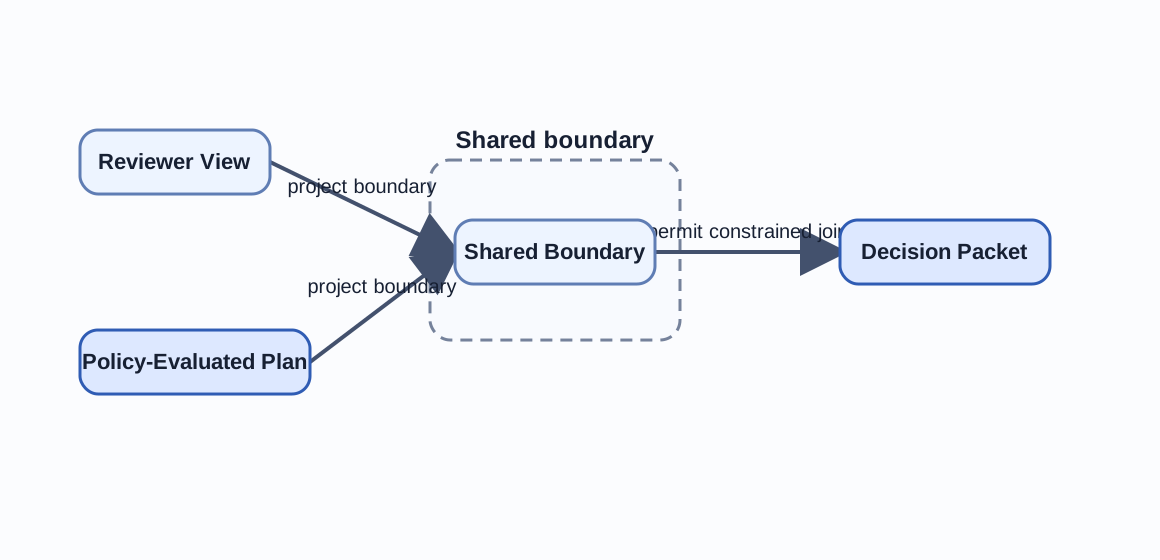
For the running example, the reviewer-facing Decision Packet and the runtime-side Policy-Evaluated Plan should be joined only where they point to the same Change Identity, the same Repository Scope, and the same Approval Route ID.
This is stricter than an ordinary database join. Matching one identifier is not enough if route labels or policy meanings differ. The pullback discipline says that the repository should refuse the join instead of hiding the mismatch behind one coerced record.
The shared-boundary definition therefore acts as the contract for valid joins. It lets the team state clearly which reviewer evidence, runtime evidence, and verification evidence may be treated as one integrated context. If one side violates that contract, the right response is to narrow the join or redesign the boundary.
Figure 7.1 shows the constrained join that the shared boundary is supposed to permit.
Figure 7.1. Constrained joins remain valid only through one preserved shared boundary.
Reader takeaway. Integration is governed only when every joining branch projects the same route, scope, and policy meaning onto one shared boundary.
Formal bridge.
Pullback sketch:

Decision Packet --------> Reviewer View
      |                        |
      v                        v
Policy-Evaluated Plan -> Shared Boundary
The join is valid only where both lower paths preserve Change Identity, Repository Scope, Policy Classification, and Approval Route ID.
If one of those boundary elements drifts, the repository no longer has the constrained join that justified treating the records as one governed packet.
A weaker alternative is a permissive integration row keyed only by Change Identity.
That row can still be materialized even when Approval Route ID or Policy Classification has drifted.
It may be useful for debugging.
It is not a governed join.
If the reviewer-facing packet says Standard Review Path while the runtime-side plan says Escalated Review Path, a database join can still return one row on the shared change identifier.
The pullback cannot.
Its shared-boundary square no longer commutes, so there is no governed integrated record to trust.
An ordinary join tolerates disagreement and asks downstream consumers to repair the meaning later.
The pullback earns its keep by refusing that repair strategy and surfacing the mismatch exactly where the supposed shared boundary fails.
Operationally, a reviewer who sees one route while the runtime logs another is not looking at a minor inconsistency. The repository has lost the constrained join that justified treating those records as one governed approval path.
Provenance and policy preservation
Pullbacks are useful only if the joined structure keeps the origin of its parts visible. In Chapter 07, provenance means knowing which policy evaluation, which route selection, and which source artifact contributed to the joined view. Without that record, the join may still exist, but it will be hard to trust or audit.
The running example keeps provenance lightweight rather than elaborate. The traceability matrix already tells the reader where core claims are represented. The shared boundary tells the reader which keys and route labels must match before those claims may be treated as one integrated record. Together they provide a repository-level answer to a common review question: which policy result and which approval route produced this supposedly integrated state.
This also explains why policy preservation matters.
If one system uses exception-required while another reduces that outcome to a generic pass, the pullback has not preserved the same policy meaning.
The join should be rejected or mediated by an explicit schema mapping.
That is safer than pretending that provenance can compensate for a lost constraint.
Pushouts for merger and migration
Pushouts matter when a team wants to replace or merge components along a shared boundary. In software work, that means the replacement should happen through an interface the old and new structures can both honor.
Replacing components without losing meaning
The running example models this with design/replacement-plan.md.
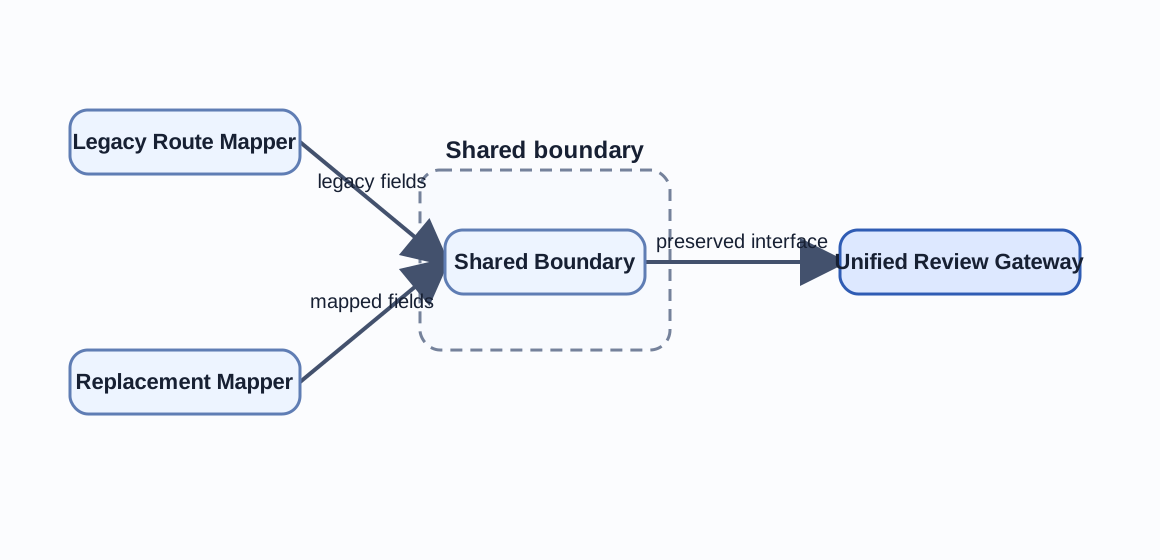
The plan replaces a Legacy Route Mapper with a Unified Review Gateway.
The migration is safe only if both sides preserve the same shared review boundary while the cutover happens.
That is the engineering reading of a pushout in this chapter. The team is not merely deleting one component and inserting another. It is merging the old and new structures along a shared interface so downstream artifacts can continue to consume the same approval meaning.
The shared interface is small on purpose.
It carries Change Identity, Repository Scope, Policy Classification, and Approval Route ID.
If the new gateway changes any of those without an explicit mapping, the replacement has already stepped outside the pushout discipline.
The result might still compile.
It would no longer preserve the boundary that made the migration governable.
Figure 7.2 makes the replacement path visible before the chapter turns back to the pushout sketch.
Figure 7.2. Controlled replacement stays anchored to one shared boundary.
Reader takeaway. Replacement is safe only when legacy and new outputs stay comparable on one preserved boundary during migration.
Formal bridge.
Pushout sketch:

Legacy Route Mapper ----> Unified Review Gateway
        |                          ^
        v                          |
   Shared Boundary <---- Replacement Mapper
The pushout claim is that both old and replacement components meet at one shared interface before downstream artifacts consume the new gateway. If the cutover changes the shared boundary itself, the migration is no longer a controlled replacement of the same approval path.
A weaker alternative is a cutover script that flattens legacy and new outputs into one generic status field after the swap. That can keep dashboards green while silently erasing route or policy distinctions that the reviewer and the traceability matrix still depend on. The result may look migrated because a downstream consumer still receives one record. It is not a pushout-like replacement because the common interface is being reconstructed after the fact instead of being preserved during the cutover. Pushout reasoning matters precisely because it forces the team to preserve the boundary before claiming that the replacement is complete.
Blind cutovers are dangerous in AI-assisted systems. Tooling can be replaced quickly, but approval meaning changes more slowly. Pushout-style thinking forces the team to ask which boundary is being preserved before it celebrates a successful swap.
Controlled schema and interface migration
Real migrations often fail through schema drift before behavior is obviously wrong. The replacement plan therefore includes an explicit schema mapping from legacy field names to the shared boundary. That mapping is not a clerical detail. It is the evidence that old and new structures can be compared on one contract.
In the running example, legacy_policy_status becomes Policy Classification.
legacy_route_hint becomes Approval Route ID.
Those renamings are safe only if they preserve the same route semantics and the same review obligations.
If a field is dropped or collapsed during the migration, the pushout should be treated as invalid or incomplete.
Controlled migration therefore has a staged shape. Run both components in shadow mode. Compare the outputs at the shared boundary. Cut over only when the old and new structures preserve the same approval meaning. Then keep the recorded lineage long enough to explain why the old path was retired.
This is more work than a one-step replacement. It is also what makes the migration reviewable after the fact. Without the shared interface and the schema mapping, the team cannot prove what the new component actually preserved.
Conflict resolution and traceability
Integration and migration rarely fail because nothing matches. They fail because some things match while the most important assumptions do not. The response has to be explicit enough that later reviewers can reconstruct what was reconciled and what was rejected.
Reconciling incompatible assumptions
When assumptions conflict, the first task is to name the level of the conflict. Is the mismatch in keys, in route labels, in policy classifications, or in approval meaning. The answer determines whether the team needs a narrower pullback, a fuller schema mapping, or a redesign instead of an integration.
One simple rule is enough in the running example.
If the conflict touches the meaning of Approved Change, do not hide it inside a migration step.
That is a redesign problem, not a routine merge.
If the conflict is only in field naming or artifact location, a controlled mapping may be enough.
This is also where the coherence failure artifact becomes useful. It shows what happens when the repository tries to treat mismatched route or policy semantics as if they were harmless presentation differences. That example gives the reviewer a concrete negative case against which migration proposals can be measured.
Recording transformation lineage
Transformation lineage records how one structure became another during integration or migration. It is more specific than a generic audit log because it explains which boundary mapping, comparison result, or cutover step produced the new artifact state. For Chapter 07, lineage is the bridge between categorical language and repository evidence.
In practice, the lineage record should answer four questions.
- Which old component produced the previous route decision.
- Which new component produced the replacement decision.
- Which shared boundary fields were compared.
- Which divergence, if any, was accepted during the overlap period.
This record does not need to be heavyweight. It does need to survive long enough that another engineer can audit the migration without reverse-engineering old tool output. That pairing keeps migration notes anchored to the replacement plan and the traceability matrix instead of treating them as ephemeral operations chatter.
Integration and migration heuristics
The formal constructions help because they sharpen judgment. They do not remove the need to decide when integration is worthwhile and when redesign is safer.
When to stop merging and redesign
- Stop merging when no stable
Change IdentityorRepository Scopecan be agreed across the participating artifacts. - Stop merging when route labels can be matched only by collapsing distinctions that governance still depends on.
- Stop merging when policy vocabularies disagree in ways that cannot be preserved by an explicit schema mapping.
- Stop merging when the combined system would hide a change to
Approved Changesemantics behind an interface rename or tool replacement.
Criteria for a safe migration plan
- The old and new components share one small boundary that downstream artifacts can already consume.
- A documented schema mapping explains how legacy fields map to the shared boundary.
- Shadow execution compares route and policy outputs before cutover.
- Provenance and transformation lineage remain available long enough to audit the replacement.
- The migration preserves the same approval meaning and the same human review obligations after cutover.
If these criteria cannot be met, the repository should narrow the scope of the migration or redesign the boundary first. Chapter 08 follows the same governed meaning into a different failure mode: parallel preparation that looks efficient until one missing fan-in breaks the approval story.
Summary
- A pullback is a constrained join, which means the repository should merge artifacts only where
Change Identity,Repository Scope, and policy meaning already agree. - A pushout is a controlled replacement, which means migration should proceed through one preserved boundary and an explicit schema mapping rather than through blind cutover.
provenance,schema mapping,shadow execution, andtransformation lineagematter because they keep integration and migration claims auditable after the new route goes live.
Review prompts
- Is your current change better described as a pullback, a pushout, or not ready, and which missing condition makes that classification true.
- Which shared boundary in your system is still too vague to support a constrained join without collapsing important distinctions.
- Which schema mapping, provenance record, or lineage trail would another engineer need in order to audit your latest cutover without reverse-engineering logs.
Notes and Further Reading
- Riehl and Mac Lane provide the formal background for pullbacks and pushouts, but this chapter is best reread with them when you need to test whether a join or replacement really preserves one governed meaning.
- Bass, Clements, and Kazman help bridge these constructions back to integration work because they keep interfaces, quality tradeoffs, and migration boundaries explicit.
- Evans is valuable here when the shared boundary is unstable because the language of the domain is still unsettled before any schema mapping or migration plan is written.